Monday, June 23, 2014

June 22 – Corfu, Greece


This morning we arrived at Corfu, the second largest of the Ionian Islands. It lies at the entrance to the Adriatic Sea not too far from the very tip of the heel of Italy.  We were supposed to tender in today, but apparently the captain of the Queen Elizabeth very kindly offered us his docking space instead.

Corfu has a very long and rich history with evidence of inhabitation as far back as the Paleolithic Era (70,000 to 40,000 BC).  Like most of the places in this part of the world it has been ruled by the Greeks, Romans, and Byzantines.  After the fall of the Byzantine Empire it came under the rule of the Venetian Republic.  Venice added to the fortifications of the town of Corfu and influenced the building style so that many of the buildings in the old town have little balconies and architectural details reminiscent of Venice.

The patron saint of Corfu is St. Spyridon whose remains are in the church named for him in Corfu Town.  He is revered on the island and is believed to have performed miracles before and after his death (in the 4th century).  One interesting story involves an invasion attempt by the Turks in 1716.  As the invaders stormed the beach St. Spyridon was seen brandishing a lighted torch and waving a Venetian flag.  This apparition energized the defenders and scared the Turkish soldiers who eventually retreated.  Because of the esteem in which the Saint is held, every family’s second son is named “Spiro.”  There are lots of Spiros on the island!

A couple of years ago when we visited the island we took a comprehensive tour so today we opted for something different.  With a group of just 14 people we set out in a minibus to the old town.  There we had a brief walking tour past the Old Fortress and the Palace of St. Michael and St. George and then had about 90 minutes to wander through the streets of the town.  They are lined with little shops selling everything from typical tourist things to furs, something which it’s hard to imagine anyone from the island ever needing.
Old Fort in Corfu Town
Palace of St. Michael and St. George
Wrought iron spiral staircase the royals used to get down to the sea from the palace

Our next stop was the highlight of the day – a cooking demonstration and lunch afterwards.  We drove out to the countryside and went to a restaurant called Spiros & Vasilis.  This was a lovely spot with a restaurant and the chef’s house next door.  We were seated on a patio shaded by trees that I was told were “laknis” trees.  The chef greeted us and, yes, his name was Spiro.  He proceeded to show us how to prepare our luncheon menu.  We had olives that he had cured himself and feta cheese with olive oil and paprika.  Next he demonstrated how to make the two dips he served.  The first was Taramosalata, a dip made of fish roe and boiled potatoes, and next was Tzatziki, made with cucumbers, yogurt and garlic.  Both were very tasty, but the tzatziki was exceptional.  It was a little zesty and was wonderful on the freshly baked bread accompanying the meal. Next Spiro prepared a Greek salad with tomatoes, cucumbers, onions, feta and olive oil.  We asked why there was no vinegar and his reply was “then it wouldn’t be a Greek salad.”
Our chef Spiro with Brenda our guide and interpreter
Our beautiful luncheon venue

Our main course was Moussaka.  He prepared it with golden fried thinly sliced potatoes, grilled eggplant rounds, a meat sauce made with ground veal and a béchamel sauce topped with grated cheese.  It was delicious!  For dessert we had some of the sweetest watermelon, honeydew and cherries I’ve ever eaten.  To wash everything down we had ouzo to begin with followed by red and white wine.  Everything tasted great.  I’m sure the setting had something to do with it as a light breeze blew and we could smell the flowers alongside the house and kitchen.


Then it was time to head back to the ship for a fairly early sailaway.  There were four ships in Corfu today and I think we were lucky we stopped first in the old town.  Later in the day it was probably mobbed.  As we sailed we passed Corfu town and had a good view of the fortress and town from the sea.  It was a nice day.
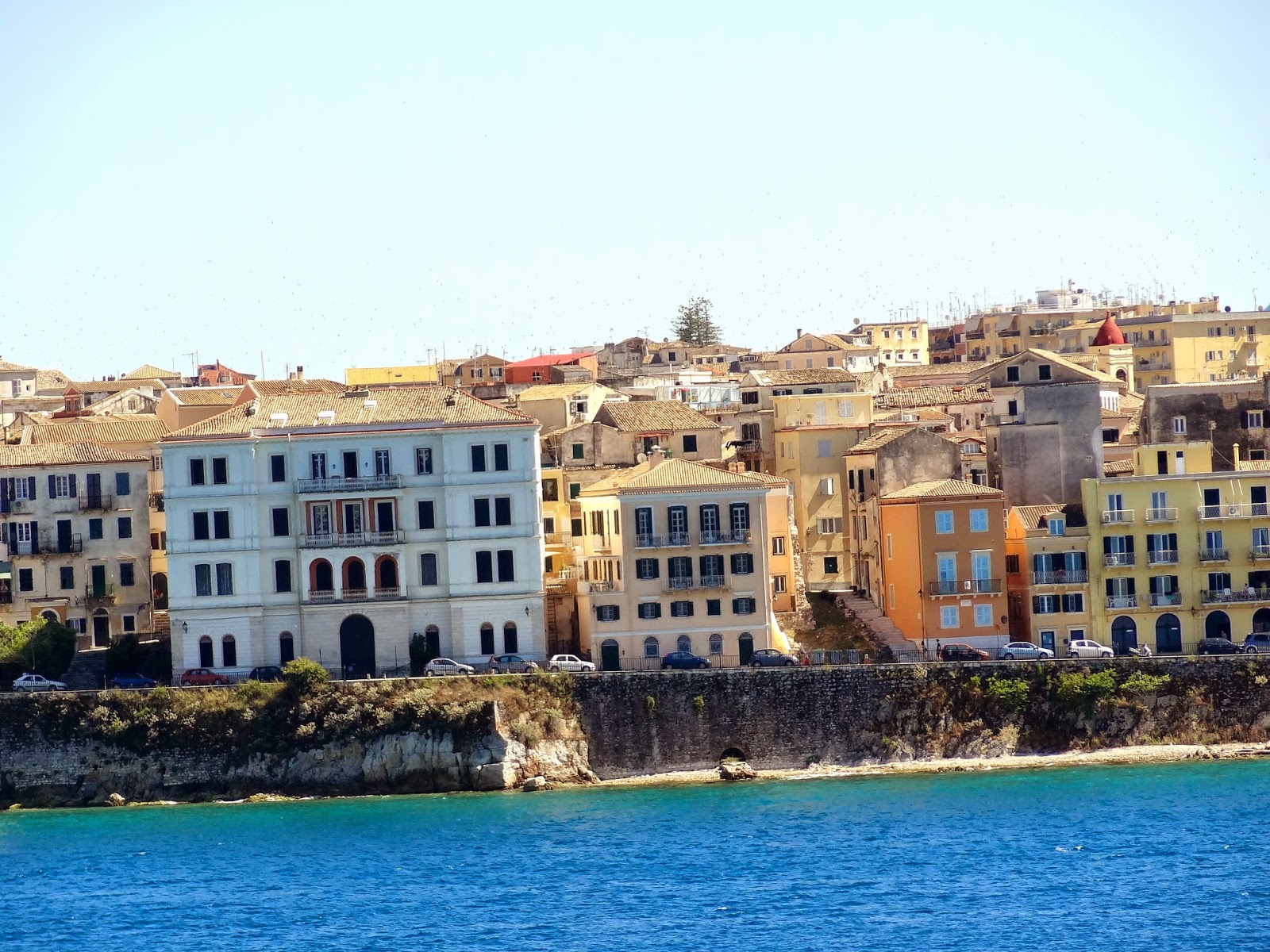
Corfu Town from the sea
The spire of St. Spyridon towering over the old town

June 21 - Dubrovnik, Croatia


Katie has reported on her day in Dubrovnik with pictures from her walk around the wall and her lunch there.  I guess I should have persisted and stayed in the throng pushing to get in through the gate.  Oh, well! We did learn from someone we met later that had we taken a taxi we could have been dropped at the other gate near the water.  There were apparently far fewer people there.  It’s something to be remembered in the future, especially if there are 5 ships in port.

When we sailed from Dubrovnik we had some nice views of the coastline which is pretty spectacular.  Once again the seas were absolutely calm. As we rounded a point of land on our southerly course we could see what I thought was the old walled city far in the distance.  With the camera zoomed as far it would go we took some shots and they actually turned out better than expected.

The bridge to Dubrovnik with the Regal Princess still docked
Splendid Croatian coastline
The old walled city from far out at sea


Saturday, June 21, 2014

Dubrovnik, Croatia

The port of Dubrovnik, Croatia, was packed with tourists, since the Emerald Princess was one of five cruise ships docked here today. Most of the visitors, including me, wanted to walk around the Old City of Dubrovnik, which is a picturesque walled medieval town. My mother and I made our way to the Pile Gate, which is one of only a couple entrances to the Old City, and it was absolutely packed with tourists.

The photo you see below was taken in the late afternoon on my way out, when it was much calmer. Going in, the outside was crammed with wall-to-wall people trying to get in, and a few people trying to squeeze through and get out. My mom decided not to brave the crowds, so I went onward myself. I’ve never been in such a press before – by the time I got inside the gate itself, people were shoving, men were yelling in Italian and Croatian, and a few times I even worried that people might start fighting with each other as we were all jostled and squeezed. Thankfully, just through the gate things were much better, and the tourist traffic during the rest of my visit was busy, but not overwhelming.


If you’re not taking an organized tour in Dubrovnik, it’s easy to see a great deal of the city on your own, and one of the most pleasant activities is to walk around the ramparts. There are several entrances where one must buy a ticket, and then it takes about an hour to walk around, with many opportunities to climb towers and take photos looking out over the red tiled roofs of the Old City, the fortresses of the wall itself, and the scenic coast. Here are a few views from the Dubrovnik city walls:


After walking around the walls, I spent some time wandering through alleys and small streets, and ended up eating lunch at one of many open-air cafes, Konoba Jezuite. You probably can’t go wrong with any little café in Dubrovnik, most of which serve local seafood. My lunch consisted of a local roasted fish called a giltfish, with a side of Dalmatian chard.


Finally, here are a couple of views of Dubrovnik from ground-level, one of the Old Harbor, and another along the main street, the Placa.


June 20 - Ljubljana, Slovenia


This morning we docked in Koper, Slovenia.  We gathered for our tour to Ljubljana, the capital city, with our very informative guide Tina.  Slovenia is one of the republics formed from the former Yugoslavia.  This country was fortunate because upon declaring its independence it only experienced a 10-day war unlike some of the other countries like Bosnia, Croatia and Kosovo.  Slovenia is small with only a 40 mile coastline.  On our drive inland to Ljubljana we passed through hills covered with forests with an occasional farm here and there.  In the distance we could see the  Dinaric Alps which form part of the border with Austria.  Slovenia is bordered by Italy, Austria, Croatia and Hungary. Like most of the places we’ve visited, this country has been under the rule of many civilizations including among others Rome, the Holy Roman Empire and in the most recent past Austria-Hungary.

Ljubljana lies at the confluence of three rivers including the Ljuljanica which runs through the downtown old city.  Dominating the landscape is the Ljubljana Castle which was the home of the dukes who owned the city.  The downtown has been made into a pedestrian zone entirely.  The area is pretty small and easily walked.  Our bus dropped us off at the square which holds the central market.  As a lover of markets, I was impressed with this one.  It’s the largest outdoor market in Europe and the place was full of stands selling a vast array of fruits, vegetables and flowers.  When we passed the section of fruit vendors, the smell of strawberries was absolutely incredible! 
Ljubljana Castle above the city
The beautiful market

Our tour took us on a stroll through the old city.  The river has many bridges in just a short distance including one set called the Triple Bridge, three built nearly side by side. The dragon is the symbol of Ljubljana.  While no one is certain why that is, our guide told us that legend has it that Jason (of the Argonauts and Golden Fleece fame) sailed to the area on his quest.  While near modern-day Ljubljana he fought and killed a dragon before continuing his journey.  Whatever the reason is, the symbol is found everywhere on buildings and bridges.

Some stylized Ljubljana dragons

There are a number of large squares, some with trees, others with just fountains.  There are lots of large statues and sculptures around.  Many are of famous Slovenian poets and artists.  One square in particular had an interesting story to the statue.  It was that of Slovenia’s most famous poet.  He’s looking across the square at the house where his  true love lived.  Over time a tree grew and blocked the view so a sculpture of his lady looking out a window toward him was placed on building within his line of sight.
The poet

and his true love returning his gaze

We had a typical Slovenian lunch in a restaurant nearly across the street from the Cathedral of St. Nicholas.  That was the Cathedral in which Katie’s chorus performed two years ago when it did a tour.  She and I met at the end in Venice and did a cruise that took us to the eastern Mediterranean.  The Cathedral has some interesting bronze doors.  One set represents the history of Slovenia from ancient times to the present.  They were commissioned and installed for a visit by Pope John Paul II. 

Following lunch we made our way back to the market square and boarded our bus for our return to the ship.  At the dock a group of Slovenian musicians was playing traditional folk music.  They played until we sailed away and then waved goodbye as we went out past the breakwater.

It was a very nice day!  Katie had told me after her visit 2 years ago that the country was beautiful. She was right!  I lived in what was then Yugoslavia many years ago and passed through Slovenia often on our way to a beach resort or Italy in the summertime.  It was so long ago that my memories are faint, but I do know that the place has changed dramatically.  It’s a country I would go back to again and would like to spend more time visiting.


Friday, June 20, 2014

June 19 - Venice


We sailed into Venice around 8 AM.  It was a gorgeous day with perfect blue skies and a moderate temperature, unlike when Katie and I were here in 2012.  As we sailed past the Doge’s Palace and San Marco I could see that the Bridge of Sighs was no longer covered in some advertisement as it was the last two times I was here.  It was nice seeing it again.
Hooray!  No advertisements


Apart from the Emerald Princess at the next dock over was the Regal Princess, which is absolutely enormous!  Two small cruise ships were tied up along the Giudecca Canal. Perhaps because there weren’t more big ships docked, Venice didn’t seem as crowded as it has on previous visits.

After breakfast we headed ashore to wander on our own.  Our first stop was to purchase a day pass on the vaporetto.  We decided to take it all the way to Lido.  After the stop at the Rialto Bridge we were able to get seats up in the bow of the boat.  That’s my favorite spot to see the sights of Venice.  Once on Lido we changed to the vaporetto to Murano, our destination for lunch. 

Murano is such a lovely place! It has a lot of the charm of Venice without the throngs of people.  We walked around looking at the Murano glass sculptures on display.  Some are exquisite; some are more unusual.  The only one that seems to be permanent is the blue one near the clock tower.
A glass flower garden
Another of the public sculptures

After walking along the main canal we had a nice lunch at a restaurant we’d been to before and then headed back to Venice. We found our way to Piazza San Marco and had a drink at a café on the square.  The prices are astronomical but you pay for the ambiance.  It was getting late so we headed for the vaporetto.  As we made our way to one of the stops for San Marco we found the little garden, Il Giardetti, which we’d never noticed before.  It’s a little sea of tranquility in the midst of the chaos that is the San Marco area.  There was a nice view of the Campanile’s top from the garden.


After a crowded ride on the boat and a quick trip on the People Mover we walked back to the ship.  According to my Fitbit, we walked a little over 6 miles and we were both tired after a long but lovely day.

Wednesday, June 18, 2014

June 17 - Malta


After an uneventful couple of sea days we arrived early in the morning in Malta.  The harbor is in the capital city of Valletta, named after a 16th century Grand Master of the Knights of St. John.  The harbor is impressive, surrounded by fortresses and massive walls and ramparts built by the Knights to repel invaders.  I think it’s one of the more spectacular ports to sail into because of all the fortifications.

St. Elmo's Fortress
Valletta sea walls

Malta is the largest island of a small archipelago that lies about 80 km south of Sicily.  Its location and good harbor have contributed to its importance through the millennia.  There are ruins dating back to as early as 5000 BC.  It’s thought the first inhabitants were Stone Age people who came from Sicily. During the morning on our tour we visited the Tarxien Temples which were probably built by some of the earliest inhabitants.  The ruins were discovered in 1914 by farmers plowing their fields.  The complex which was unearthed is large and includes massive monoliths.  Giving a clue to how they may have been put into place are many small round stones which probably were used as rollers.  Many of the  large stones are carved with a spiral design that probably signifies eternity.

Tarxien Temple Complex

Round stones used as rollers
 
Spiral carvings were everywhere
The Fat Lady

Subsequently, the Phoenicians had several trading posts.   The Carthaginians used the island as a naval base during their wars with Rome.  Over the centuries the island has belonged to the Roman Empire, Byzantine Empire, Normans, Spanish and Holy Roman Empire.  In 1522 The Knights of St. John, who were originally Crusaders, were given Malta by Emperor Charles V after they were expelled from first Palestine and then the island of Rhodes by the Ottoman Emperor.  Their first capital was the city of Mdina.  It’s a walled city with only 650 residents today.  The only cars allowed within the walls are ones delivering things and then only at certain times of the day.  The place is tranquil and the streets are lined with palaces built by the knights in a variety of styles.
Quiet street in Mdina


Supposedly St. Paul was shipwrecked on Malta on his way to Rome.  During his stay on the island he converted the Roman governor Publius to Christianity. Publius became the first Bishop of Malta.  This archway over a gate in Mdina depicts St. Paul in the middle, Publius on the left and St. Agatha on the right.


In Mdina is one of the co-cathedrals of Malta.  In preparation for the Feast of St. George which is a big day on Malta,  the interior walls of the cathedral had been draped in red silk damask and the silver and gold had all been highly polished.  The plain exterior of the building was a real contrast to the resplendent interior. 
Main altar in the Cathedral


When the Knights occupied Malta they continued naval attacks against the Turks. Knowing that eventually they would be attacked by the latter, they built fortifications at a rapid pace.  The attack came in 1565 when Suleiman the Magnificent attacked with 40,000 troops.  The Knights who numbered 541 along with several thousand brave but untrained Maltese held off the Turks for 4 months until help finally arrived from Sicily.  Suleiman retreated in defeat with 30,000 of his men killed.

The next two centuries were relatively peaceful and the Knights rebuilt fortifications and constructed 2 magnificent cathedrals.  Then along came Napoleon in 1798.  He was on his way to Egypt but stopped for 6 days in Malta and left some troops behind.  During the next 2 years the French looted many of the treasures on the island to the chagrin of the Maltese.  In 1800 they had enough and they revolted.  They also invited the English under Lord Nelson to help them.  The French were ousted and for the next 160 years Malta became part of the British Empire.  The relationship was evidently a good one.  Unfortunately, though, because it was British and in a strategic location, Malta suffered heavy bombing during WWII.  It was said that in one two day period Malta received as many bombs as London did during a two month period. Malta became independent in 1964, a republic in 1974, and today is part of the European Union.  With a population of around 250,000 it has an unemployment rate of just over 2%.  The principal industry is tourism.


As a fan of “The Maltese Falcon,”  I looked for a connection.  I saw this on a wall in Mdina.


Valletta, Malta

Greetings from Malta! Neither of us had visited the island before, so we took an all-day tour, to hopefully see and learn as much as possible. My mother will blog about the sights we saw in the morning, so I’ll write a little here about our lunch and travels in the afternoon.

After visiting Mdina and Tarxien in the morning, our group ate a lunch of typical Maltese cuisine. I don’t know about you, but before today I had no idea what Maltese food was like! The buffet had many cold or room temperature salads, including olives stuffed with meat, sausages cut up with sun-dried tomatoes, marinated mushrooms, chickpea paste, red lentil paste, shredded carrots and red cabbage in a vinaigrette, and a hard, feta-like cheese encrusted in black pepper.


After lunch, we returned to Valletta, which is where the Emerald Princess was docked. Valletta, the capital of Malta, is named after La Valette, the first Grand Master of the Knights of Malta who founded the city when the knights took over the island in the 16th century.

The stamp of the Knights of Malta is all over the island. The distinctive Maltese cross appears on banners and in carvings everywhere, and nowhere more than inside the Co-cathedral of St. John in Valletta. On the outside, the building is quite plain, but the interior of the cathedral is completely covered with sumptuous, gilded decoration and furnished with precious objects, many of which were gifts sponsored by the island’s knightly rulers.


The downtown area in Valletta is mostly pedestrian only, and the streets and buildings are all made of distinctive limestone. The climate in Malta is very arid, so even though it was cloudy all day, it never rained, and the city all looks like a dry, dusty beige. Valletta was heavily bombed during World War II, so many of the buildings have been reconstructed. The photo below shows the columns remaining from a famous opera house that was destroyed. The city has recently decided not to rebuild the opera house, but instead to turn it into an outdoor amphitheater, which they’re currently in the process of building.


Malta is also an interesting place because of its unique language. Maltese is a member of the Semitic language family, related to Hebrew and Arabic, and it’s the only such language that is written with the Latin alphabet. Check out the sign below for an example of the same sentences in English and Maltese, as well as a convenient diagram reminding visitors not to pitch themselves from the city walls.


Finally, here’s a panoramic view of the harbor as we were sailing away. Farewell to Malta!